 EN
EN

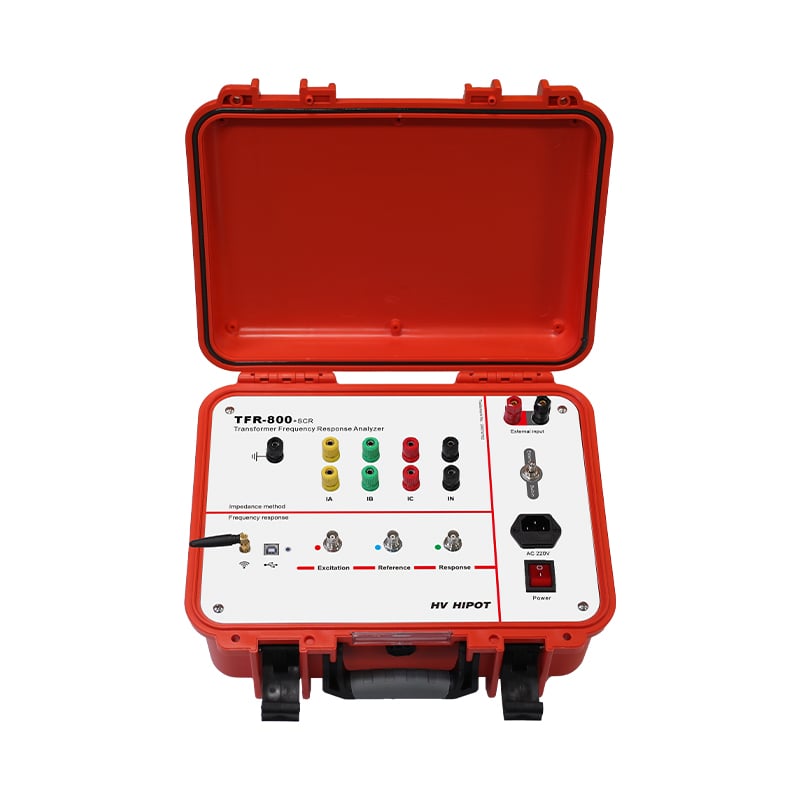
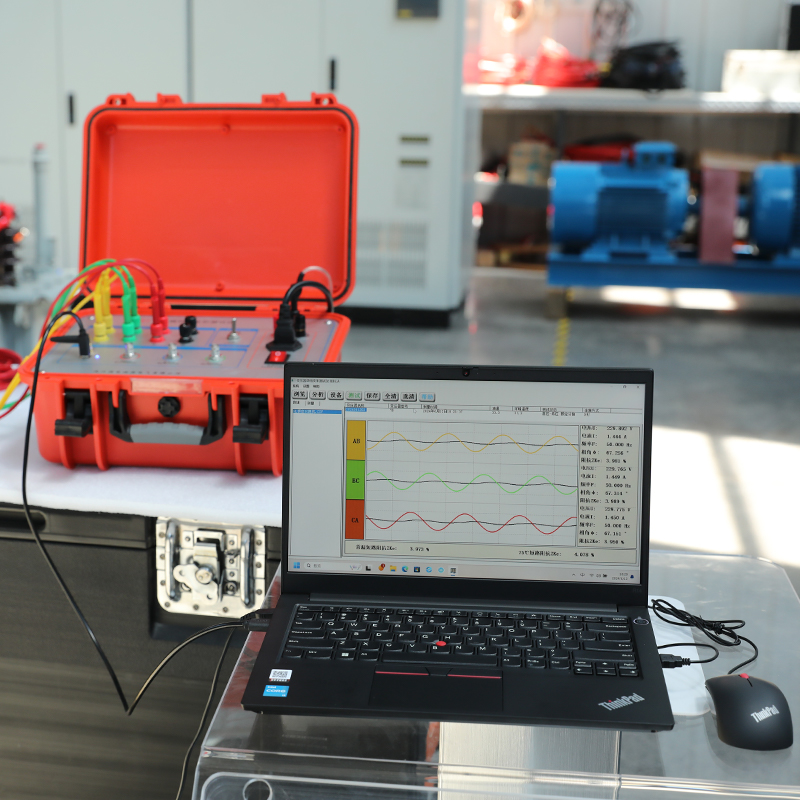
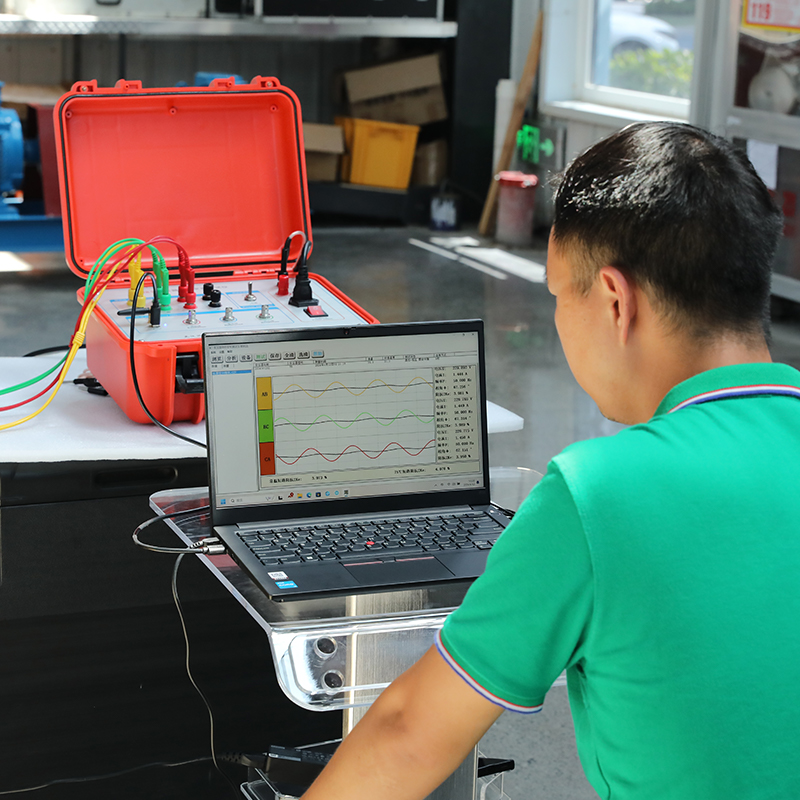
TFR-800 Transformer Frequency Response Analyzer (SFRA Method)
TFR-800 transformer frequency response analyzer adopts SFRA sweep frequency method, 10Hz-2MHz dual channel, ±0.1dB accuracy. Auto diagnoses winding deformation, core shift, inter-turn short circuit, supports fingerprint comparison & correlation calculation.
- Description
- Specifications
- Applications
- Advantages
- FAQ
- Recommended Products
Description
TFR-800 is a professional portable SFRA winding deformation tester designed for power utilities, transformer manufacturers, EPC contractors and third-party testing institutions. It is dedicated to non-intrusive mechanical integrity evaluation of distribution and power transformers during factory inspection, commissioning acceptance, routine preventive test and post-short-circuit fault diagnosis, strictly complying with IEC 60076-18, DL/T 911-2016 and relevant international standards.
Based on the classic Sweep Frequency Response Analysis (SFRA) principle, the instrument injects a low-voltage sweep excitation signal into the transformer winding, measures the amplitude-frequency and phase-frequency response characteristics, and compares the measured fingerprint curve with historical reference data. It can sensitively identify various mechanical defects including axial displacement, radial buckling, inter-turn short circuit, core shift, clamping structure loosening and winding bulging, without removing the transformer tank or disassembling windings.
It is widely used for 10kV ~ 500kV oil-immersed power transformers, dry-type transformers and special transformers, and is an essential diagnostic tool for transformer condition-based maintenance and fault root cause analysis.
Specifications
| Parameter | Specification |
|---|---|
| Test Principle | Sweep Frequency Response Analysis (SFRA) |
| Acquisition Channels | 2 channels (excitation + response), synchronous sampling |
| Sweep Frequency Range | 10Hz ~ 2MHz |
| Sweep Modes | Logarithmic / Linear, 2000 points configurable |
| Frequency Accuracy | 0.001% |
| Amplitude Measurement Range | -100dB ~ +20dB |
| Amplitude Accuracy | ±0.1dB (-40dB ~ +20dB interval) |
| Phase Measurement Range | -180° ~ +180° |
| Output Signal Amplitude | 0.2Vpp ~ 20Vpp, automatically adjustable |
| Input Impedance | 1MΩ // 50Ω matching |
| Output Impedance | 50Ω |
| Diagnosis Function | Auto correlation calculation, 4-level deformation severity grading, multi-band analysis |
| Data Storage | Built-in large-capacity memory, transformer fingerprint database management |
| Communication Interface | USB 2.0 (U-disk export & PC software connection) |
| Power Supply | Built-in rechargeable lithium battery; AC 100~240V charging adapter |
| Continuous Battery Life | ≥ 8 hours |
| Protection Functions | Over-voltage protection, input impedance matching, anti-surge |
| Operating Temperature | -10℃ ~ +50℃ |
| Ambient Humidity | ≤85% RH (non-condensing) |
| Enclosure | Shockproof portable reinforced plastic chassis with handle |
Applications
Core Test Objects
- 10kV ~ 500kV oil-immersed power transformers
- Dry-type distribution transformers and special transformers
- Transformer windings, iron cores and clamping structures
Detectable Defect Types
- Winding axial displacement and radial buckling
- Inter-turn and inter-disc short circuit faults
- Iron core shift and clamping structure loosening
- Winding bulging, distortion and mechanical damage after short-circuit impact
- Loose lead wires and structural part displacement
Typical Application Scenarios
- Power grid operation & maintenance: transformer routine preventive test, post-fault diagnosis and condition evaluation
- Transformer manufacturers: finished product factory inspection, type test and quality control
- Power engineering EPC: transformer commissioning acceptance and handover test
- Third-party testing institutions: transformer insulation diagnosis and arbitration test
- Industrial & mining enterprises: internal power transformer periodic maintenance and fault troubleshooting
Advantages
High-Precision Stable Measurement Performance
Dual-channel synchronous acquisition, 0.001% frequency accuracy, ±0.1dB amplitude accuracy → reliable fingerprint data, ensures validity of historical comparison
Intelligent Automatic Diagnosis
Built-in standard grading algorithm, quantitative evaluation of deformation severity → reduces dependence on operator experience, improves diagnosis accuracy
Non-Intrusive Efficient Test
No tank removal, no winding disassembly → complete test within 1-2 minutes per phase, greatly improves detection efficiency
Portable Battery-Powered Design
Built-in lithium battery, lightweight chassis → suitable for mobile on-site test in substations and power plants
Complete Data Management System
Fingerprint database + multi-curve comparison + one-click standard report → meets test archive and acceptance management requirements
Wide Application Range
Covers distribution transformers to EHV power transformers → one instrument meets daily test requirements of various voltage grades
FAQ
Q: What is SFRA testing and why is it used for transformer winding deformation detection?
A: SFRA (Sweep Frequency Response Analysis) injects a low-voltage sweep signal into the transformer winding and measures the amplitude-frequency response curve. The winding structure acts as a complex RLC network; any mechanical deformation will change the distributed capacitance and inductance, causing the response curve to shift. By comparing the test curve with the reference fingerprint, we can sensitively detect tiny winding deformation and core displacement without opening the transformer tank. It is currently the most effective non-intrusive method for winding mechanical defect detection.
Q: What defects can TFR-800 detect?
A: TFR-800 can detect various mechanical and electrical defects inside transformers:
- Winding mechanical deformation: axial displacement, radial buckling, bulging, distortion
- Electrical faults: inter-turn, inter-disc short circuit
- Structural problems: core shift, clamping structure loosening, lead displacement It is especially suitable for evaluating winding damage after short-circuit faults and monitoring long-term winding state changes during operation.
Q: Can the instrument automatically give diagnostic conclusions?
A: Yes. The built-in intelligent diagnosis algorithm calculates correlation coefficient and RMS deviation according to DL/T 911 standard, and grades the winding state into four levels: Normal, Attention, Abnormal and Severe. It also performs segmented analysis on low, medium and high frequency bands to help locate defect types. The diagnostic result is for reference, and final judgment should be combined with operation history and other test items.
Q: Is it necessary to power off the transformer for SFRA test?
A: Yes. The SFRA test needs to be performed on the de-energized transformer. All windings must be disconnected from the power grid and fully discharged before testing. The test signal is low-voltage weak signal, which will not cause damage to the transformer insulation.