 EN
EN

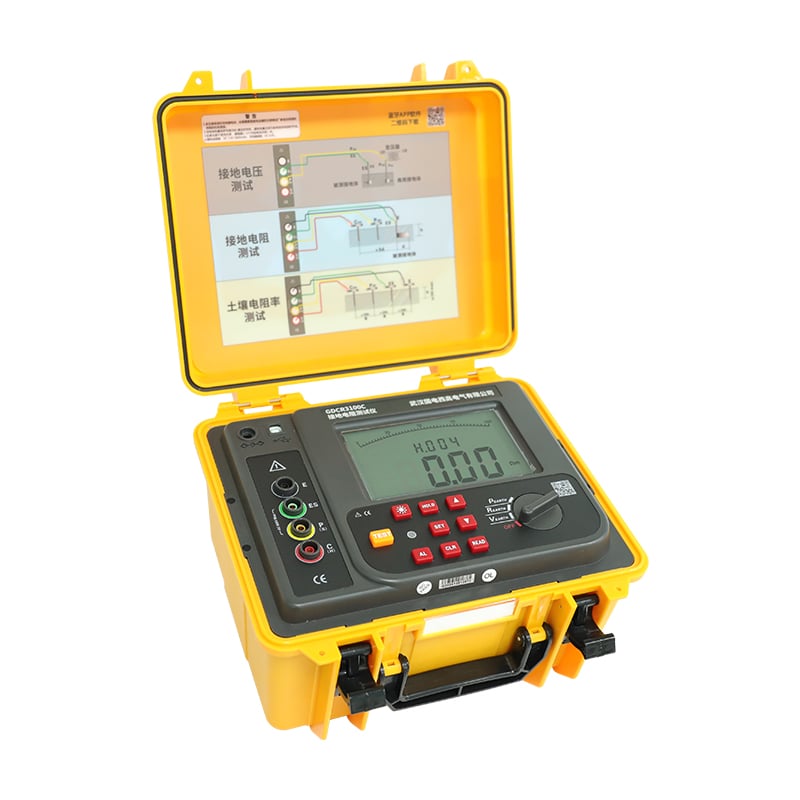
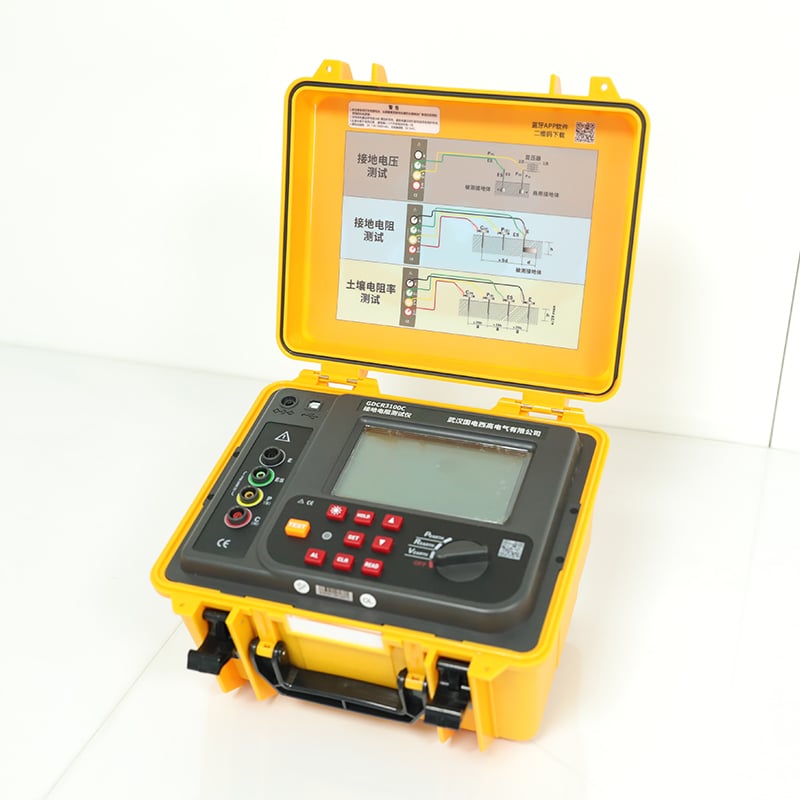
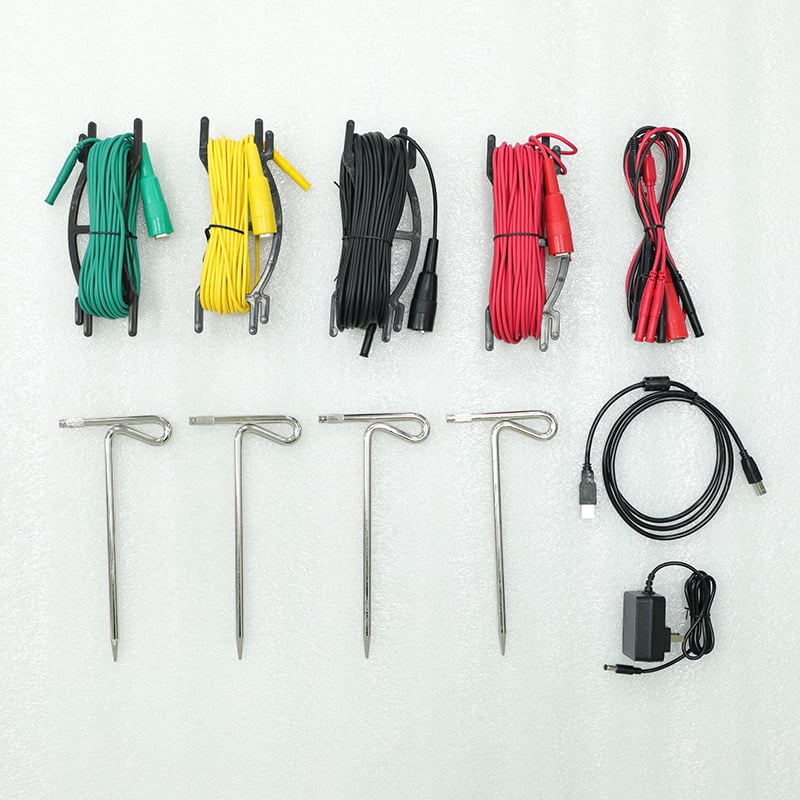
GDCR3100C Digital Earth Resistance Tester
GDCR3100C Digital Intelligent Earth Resistance and Soil Resistivity Tester with 2/3/4-Wire Measurement, FFT Anti-Interference, Built-in Lithium Battery, for Small & Medium Grounding System Evaluation.
- Description
- Specifications
- Applications
- Advantages
- FAQ
- Recommended Products
Description
GDCR3100C is a professional portable digital earth resistance tester designed for comprehensive testing of small and medium grounding systems in distribution rooms, lightning protection systems, communication base stations, industrial equipment and buildings. It strictly complies with GB/T 17949.1-2000, IEC 61557-5:2019 and DL/T 475-2017 standards, supporting 2-wire simple, 3-wire standard and 4-wire precision measurement methods to meet different test requirements.
Adopting advanced FFT (Fast Fourier Transform) and AFC (Automatic Frequency Control) technologies, the instrument automatically identifies and suppresses power frequency interference, ensuring accurate measurement results even in complex electromagnetic environments. It supports comprehensive test functions including earth resistance, soil resistivity (Wenner four-pole method), earth voltage and AC voltage measurement. The built-in 7.4V/2600mAh high-capacity lithium battery provides ≥8 hours continuous working time, eliminating the need for external AC power supply.
Specifications
| Parameter | Specification |
|---|---|
| Compliance Standards | GB/T 17949.1-2000, IEC 61557-5:2019, DL/T 475-2017, IEEE Std 80-2013 |
| Test Methods | 2-wire simple, 3-wire standard, 4-wire precision |
| Test Frequencies | 128Hz/111Hz/105Hz/9Hz (AFC automatic selection) |
| Output Current | AC 20mA maximum |
| Open-Circuit Voltage | AC 40V maximum |
| Earth Resistance Range | 0.00Ω ~ 30.00kΩ (automatic range switching) |
| Resistance Resolution | 0.01Ω (0.00~99.99Ω); 0.1Ω (100.0~999.9Ω); 1Ω (1.000~30.00kΩ) |
| Resistance Accuracy | ±(2% of reading + 3 digits) |
| Soil Resistivity Range | 0.00Ω·m ~ 9000kΩ·m |
| Resistivity Resolution | 0.01Ω·m (0.00~99.99Ω·m); 0.1Ω·m (100.0~999.9Ω·m); 1Ω·m (1.000~9.999kΩ·m); 10Ω·m (10.00~99.99kΩ·m); 100Ω·m (100.0~999.9kΩ·m); 1kΩ·m (1000~9000kΩ·m) |
| Earth Voltage Range | AC 0.0V ~ 600V |
| Voltage Resolution | 0.1V |
| Voltage Accuracy | ±(2% of reading + 3 digits) |
| Electrode Spacing | 1m ~ 100m adjustable |
| Power Supply | Built-in 7.4V/2600mAh lithium battery; USB charging |
| Battery Life | ≥8 hours continuous working, ≥500 tests per charge |
| Charging Time | ≤4 hours |
| Display | Large backlit LCD, white backlight |
| Data Storage | 300 groups (with time stamp and test parameters) |
| Communication Interfaces | USB 2.0, Bluetooth 4.0 |
| Protection Grade | IP65 (waterproof and dustproof) |
| Operating Temperature | -10℃ ~ +50℃ |
| Humidity | ≤90% RH (non-condensing) |
| Dimensions (L×W×H) | 210×120×65mm |
| Weight | ~1.8kg (including battery) |
| Enclosure | ABS+PC engineering plastic with rubber protective cover |
Applications
Core Test Objects
- Distribution systems: Distribution rooms, pole-mounted transformers, low-voltage distribution cabinets
- Lightning protection systems: Lightning rods, lightning belts, grounding grids for buildings
- Communication systems: Communication base stations, signal towers, data centers
- Industrial equipment: Motors, generators, electrical control cabinets
- Other grounding systems: Household grounding, solar power systems, wind turbines
Typical Usage Scenarios
- Power companies: Distribution network routine inspection, lightning protection system test
- Telecom operators: Communication base station grounding system maintenance
- Construction industry: Building lightning protection acceptance test
- Industrial enterprises: Internal electrical equipment grounding inspection
- Third-party testing institutions: Lightning protection certification testing, safety assessment
Advantages
Compliance with Latest International Standards
Fully meets GB/T 17949.1-2000, IEC 61557-5:2019, IEEE Std 80-2013 → test results are globally recognized
Industry-Leading FFT+AFC Anti-Interference
Automatically identifies and suppresses power frequency interference → accurate measurement even in complex electromagnetic environments
2/3/4-Wire Universal Measurement
Supports all common measurement methods → one instrument meets all small and medium grounding system test requirements
Automatic Soil Resistivity Calculation
One-click calculation of soil resistivity using Wenner four-pole method → eliminates manual calculation errors and improves test efficiency
Long Battery Life & Comprehensive Communication
≥8 hours battery life, USB/Bluetooth dual interface → meets the needs of all-day on-site work and facilitates data management
IP65 Industrial-Grade Protection
Waterproof, dustproof and shockproof design → works reliably in harsh outdoor environments
FAQ
Q: What is the advantage of 4-wire measurement compared to 2-wire and 3-wire?
A: 4-wire measurement separates current injection and voltage sensing leads, completely eliminating the influence of test lead resistance and contact resistance, providing the most accurate measurement results. It is recommended for precision testing of low-resistance grounding systems. 2-wire and 3-wire methods are suitable for simple and quick testing where high accuracy is not required.
Q: How does the FFT+AFC anti-interference technology work?
A: AFC (Automatic Frequency Control) automatically selects a test frequency that is different from the power frequency (50Hz/60Hz) to avoid direct interference. FFT (Fast Fourier Transform) then digitally filters the measured signal to further suppress residual interference. This dual technology ensures accurate measurement results even in environments with strong power frequency interference.
Q: How to calibrate the instrument?
A: GDCR3100C can be calibrated using standard resistors with accuracy not lower than 0.2 class. The calibration procedure is simple and fast:
- Enter the calibration mode in the instrument menu
- Connect the standard resistor to the test terminals
- Select the corresponding test range
- Follow the prompts to complete the calibration of each range
- The instrument will automatically save the calibration coefficients