 EN
EN

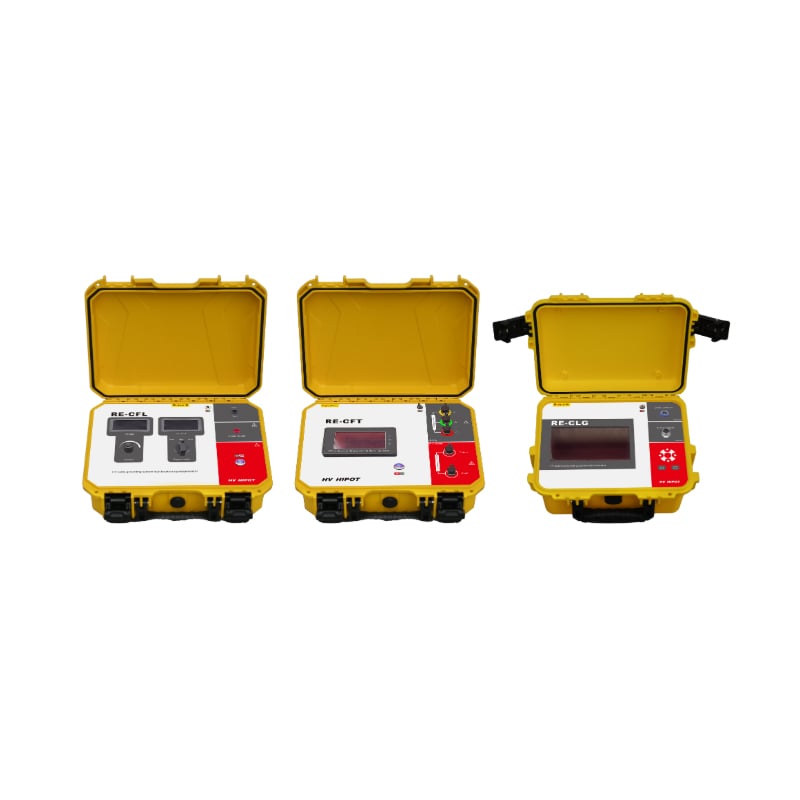
RE-CFL Detection & Defect Locating System for HV Cable Earthing System
RE-CFL Intelligent Live Detection and Defect Locating System for High Voltage Cable Earthing System, Adopting Multi-Channel Synchronous Sheath Current Acquisition and Loop Impedance Measurement, for Non-Outage Condition Assessment and Fault Localization of Cross-Bonded Single-Core Cable Metal Sheath & Earthing Circuits.
- Description
- Specifications
- Applications
- Advantages
- FAQ
- Recommended Products
Description
RE-CFL is a professional portable live-line diagnostic system designed for the metal sheath and earthing circuits of single-core high voltage underground power cables. It enables comprehensive condition evaluation without power cut, which avoids economic losses caused by scheduled outages.
The system adopts multi-channel synchronous sampling technology to capture sheath circulating current magnitude, phase distribution and waveform characteristics. Combined with four-terminal loop impedance measurement, it quantitatively assesses the operating status of cross-bonding links, cable terminals, joint earthing leads and grounding boxes. By comparing measured data with theoretical balanced values, the unit automatically identifies typical hidden defects: loose connecting bolts, corroded copper bars, fractured cross-bonding jumpers, open grounding circuits, abnormal multi-point sheath grounding and poor contact at cable accessories.
Specifications
| Parameter | Specification |
|---|---|
| Test Principle | Multi-channel synchronous sheath current sampling + four-terminal Kelvin loop impedance measurement |
| Number of Acquisition Channels | Up to 6 synchronous current channels |
| Current Measurement Range | 0.1A ~ 200A (matched with Rogowski flexible coils) |
| Current Accuracy | ±1% reading ±0.1A |
| Impedance Measurement Range | 0.1mΩ ~ 3Ω |
| Impedance Resolution | 0.1mΩ |
| Impedance Basic Accuracy | ±(0.5% reading + 0.3mΩ) |
| Supported Cable Type | Single-core HV cable with cross-bonded metal sheath |
| Analysis Functions | Sheath current vector diagram, current balance factor, loop impedance, trend recording, defect warning |
| Display | 5" high-brightness color capacitive touch screen, CN/EN bilingual |
| Data Storage | Built-in large-capacity memory, records with timestamp |
| Communication | USB 2.0 (U-disk export & PC software connection) |
| Power Supply | Built-in rechargeable lithium battery; AC 100~240V charging adapter |
| Continuous Battery Life | ≥8 hours |
| Operating Temperature | -10℃ ~ +50℃ |
| Ambient Humidity | ≤85% RH (non-condensing) |
| Enclosure | Shockproof portable reinforced plastic chassis with handle |
Applications
Core Test Objects
- Single-core HV power cables (110kV ~ 500kV) with cross-bonded metal sheath
- Cable terminals, intermediate joints, cross-bonding boxes and earthing cabinets
- Metal sheath connecting leads, grounding down conductors and equipotential links
Detectable Defect Types
- Loose bolts and poor contact at connection terminals
- Corroded copper bars and degraded contact impedance
- Broken or disconnected cross-bonding jumpers
- Open-circuit grounding circuits
- Abnormal sheath circulating current caused by multi-point sheath grounding
- Degradation of sealing and earthing conditions at cable joints
Advantages
Non-outage live testing capability
Greatly improve equipment availability, avoid outage scheduling and economic losses
Multi-channel synchronous vector analysis
Accurately evaluate sheath current balance status unique to cross-bonded cable systems
Four-terminal anti-interference impedance measurement
Reliably detect micro-resistance defects such as loose and corroded connections
Intelligent defect classification
Reduce dependence on operator experience, lower misjudgment rate for hidden sheath faults
Battery-powered portable design
Suitable for mobile inspection in cable tunnels, manholes and remote substation sites
FAQ
Q: Why perform live detection on HV cable sheath earthing systems?
A: Single-core HV cables adopt cross-bonding technology to limit induced sheath voltage. Loose connections, corrosion or broken bonding leads will cause abnormal sheath voltage and circulating current, leading to sheath overheating, insulation aging and even sheath breakdown. Most defects develop gradually without obvious failure symptoms. Live inspection enables early risk warning before permanent faults occur.
Q: Can the system locate the exact position of cross-bonding faults?
A: It can identify which cable segment and which cross-bonding unit contains abnormal defects. Combined with cable route information, maintenance crews can focus inspection on the targeted grounding box or joint section. For precise pinpointing of sheath insulation breakdown faults, a dedicated sheath fault locator is recommended.
Q: Safety precautions during live testing
- Operators must comply with substation live-line safety regulations;
- Clamp sensors shall be installed and removed carefully to avoid contact with live primary equipment;
- Do not short-circuit or disconnect existing earthing connections during measurement.