 EN
EN

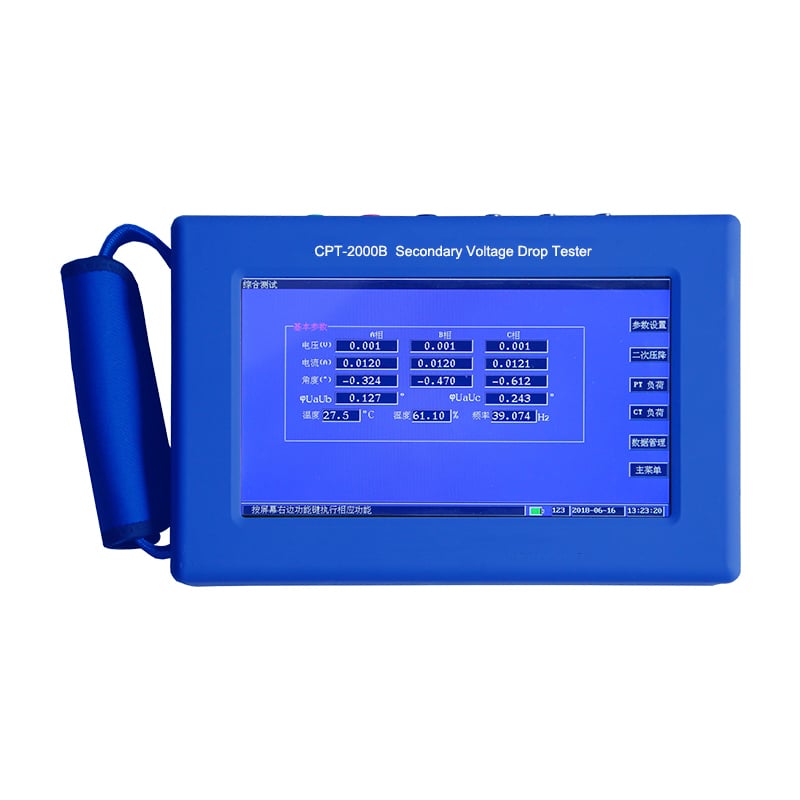
CPT-2000B Portable Carrier Secondary Voltage Drop Tester
CPT-2000B Digital Intelligent Carrier-Type Voltage Transformer Secondary Circuit Voltage Drop Tester with Power Line Carrier Synchronization, Full Wiring Mode Support, Comprehensive Error Calculation, for On-Site Electric Energy Metering Device Verification and Evaluation.
- Description
- Specifications
- Applications
- Advantages
- FAQ
- Recommended Products
Description
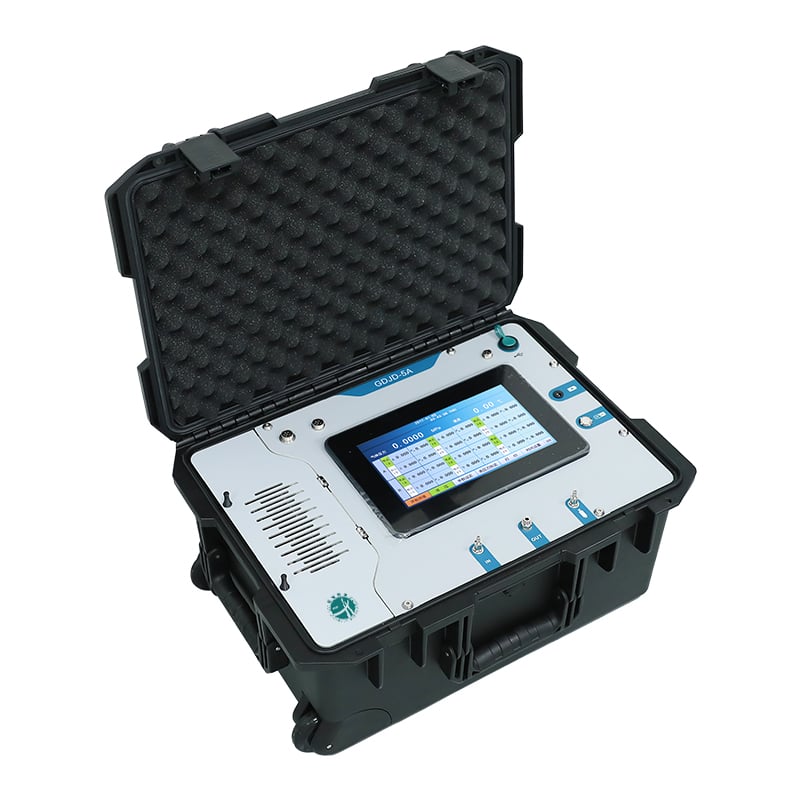
CPT-2000B is a professional on-site carrier-type secondary voltage drop tester designed for PT secondary circuit voltage drop measurement, metering error evaluation and secondary load test of electric energy metering devices in substations, power supply metering departments, industrial & commercial users and third-party testing institutions. It strictly complies with DL/T 1152-2024, DL/T 448-2016 and IEC 61869-3 standards, adopting power line carrier (PLC) synchronization technology that transmits sync signals through the existing secondary circuit itself, completely eliminating the need for long-distance test cables and greatly improving on-site test efficiency, especially for scenarios where PT and energy meter are far apart.
The instrument adopts a main unit + remote unit dual-end architecture: the main unit is connected to the energy meter end, and the remote unit is connected to the PT secondary outlet end. The two ends realize high-precision synchronous sampling through carrier communication, and automatically calculate ratio error, phase error, voltage drop amplitude and comprehensive metering error caused by secondary voltage drop. It supports single-phase, three-phase three-wire and three-phase four-wire wiring modes, with automatic identification and full-automatic test. It can be directly powered by the 30V~450V secondary circuit without additional power supply, and is also equipped with a built-in rechargeable battery for standby.
Specifications
| Parameter | Specification |
|---|---|
| Compliance Standards | DL/T 1152-2024, DL/T 448-2016, JJG 169-2010, IEC 61869-3, IEC 62053-11 |
| Test Principle | Power line carrier synchronous sampling, dual-end comparative measurement |
| Architecture | Main unit (energy meter end) + Remote unit (PT end) |
| Carrier Distance | ≤ 2000m |
| Voltage Drop Measurement | |
| Ratio Error Range | 0.001% ~ 99.9% |
| Ratio Error Resolution | 0.001% |
| Phase Error Range | 0.01' ~ 999.9' |
| Phase Error Resolution | 0.01' |
| Accuracy Class | 2 class |
| Wiring Modes | Single-phase, three-phase three-wire, three-phase four-wire (automatic identification) |
| Test Items | Ratio error, phase error, voltage drop amplitude, secondary load, comprehensive metering error |
| Input Voltage Range | 30V ~ 450V AC |
| Rated Frequency | 45Hz ~ 65Hz |
| Power Supply Mode | Secondary circuit powered (30~450V AC); built-in rechargeable battery (standby) |
| Power Consumption | ≤ 10VA (whole machine) |
| Data Storage | ≥ 1000 groups, with time stamp, power-off protection |
| Communication Interface | USB 2.0 (U-disk export) |
| Display | Large-screen dot-matrix LCD, Chinese/English bilingual |
| Operating Temperature | -10℃ ~ +50℃ |
| Ambient Humidity | ≤85% RH (non-condensing) |
| Host Dimensions | 320 × 260 × 140mm |
| Host Weight | ~ 2.8kg |
| Enclosure | Reinforced engineering plastic portable chassis |
Applications
Core Test Objects
- Voltage transformer secondary circuits: PT secondary circuits of 10kV ~ 500kV substations, distribution rooms and user metering points
- Metering devices: Trade settlement metering devices, internal assessment metering devices, gateway metering devices
- Test items: Secondary voltage drop test, secondary load test, metering comprehensive error evaluation, metering device acceptance test
Typical Usage Scenarios
- Power supply metering departments: Periodic on-site verification of metering devices, metering error census, loss analysis and management
- Industrial & commercial users: Self-owned substation metering device test, electric energy balance test, metering accuracy evaluation
- Third-party testing institutions: Metering device performance test, engineering acceptance test, metering arbitration test
- Power engineering companies: Post-construction acceptance of metering devices, commissioning and handover test
- Substation operation and maintenance teams: Daily patrol inspection of metering loops, fault diagnosis and troubleshooting
Advantages
Compliance with Latest Industry Standards
Fully meets DL/T 1152-2024, DL/T 448, JJG 169 → test methods and indicators comply with the latest power metering specifications, results are authoritative and traceable
Cable-Free Carrier Test Technology
No need to lay long test cables, PLC synchronization through existing loops → saves 80% of on-site wiring time, especially suitable for long-distance and complex site environments
Full Wiring Mode Automatic Adaptation
Single-phase / three-phase three-wire / three-phase four-wire automatic identification → one instrument covers all common metering loop tests, wide application range
Loop-Powered Convenient Design
Direct power taking from secondary circuit, no external power supply required → simplifies on-site preparation work, improves test efficiency
Full-Parameter One-Time Test
Ratio error, phase error, voltage drop, load, comprehensive error all in one → one test completes all indicators, avoids repeated wiring
FAQ
Q: What is the difference between carrier-type and traditional wired secondary voltage drop testers?
A: Traditional wired testers need to lay hundreds of meters of special test cables between the PT room and the metering room, which is heavy workload, time-consuming and easy to trip on site. The carrier-type tester transmits synchronous signals through the existing secondary circuit itself, no need for additional test cables, which greatly reduces on-site wiring workload and test time, and is especially suitable for large substations and long-distance metering loop tests. The test principle and accuracy both meet the requirements of national standards.
Q: Why is it necessary to test PT secondary circuit voltage drop?
A: There are wire resistance, contact resistance, fuses and switches in the PT secondary circuit from the outlet to the energy meter. When the load current flows through, it will cause voltage amplitude attenuation and phase shift, that is, secondary voltage drop, which will directly cause systematic errors in electric energy metering. According to DL/T 448 regulations, the secondary voltage drop of Class I and II trade settlement metering devices shall not exceed 0.2% of the rated secondary voltage. Regular testing can accurately evaluate metering accuracy and reduce economic losses caused by metering errors.
Q: Does this instrument need an external working power supply?
A: No. CPT-2000B supports direct power taking from the 30V~450V PT secondary circuit under test, and can work normally without an external working power supply, which is very convenient for on-site use. At the same time, it is also equipped with a built-in rechargeable battery as a standby power supply to cope with special scenarios where the loop cannot supply power.
Q: What wiring modes of secondary circuits can be tested?
A: CPT-2000B fully supports single-phase, three-phase three-wire and three-phase four-wire three common wiring modes, and can automatically identify the wiring mode without manual setting. It is suitable for various metering scenarios such as phase voltage metering and line voltage metering, and covers almost all conventional PT secondary metering loops.